
Wednesday, March 23, 2011
A Moving Letter to a US Army Chaplain


Friday, March 18, 2011
A Moving Purim Encounter with the Rebbe

As Purim approaches, the Avner Institute would like to present a moving encounter that took place at a Purim Farbrengen in the early 1970s, when an Israeli yeshiva student who had strayed a bit too far came back, with the Rebbe’s help. With special thanks to author and scholar Rabbi Michoel Seligson, and to Rabbi Levin.
Photo Collection
The Rebbe Archive would like to a Photo of the Rebbe at a Purim Farbrgen 1959.
Good Shabbos
Menachem
To Reveal a Soul
It was the mid-1970s. At that time I was 19 years old and like every other religious boy from Jerusalem—long coat, long peyos, a fuzz of a beard. My brothers and I went to Eitz Chaim Yeshiva. I was a good student, and it wasn't long before people began to suggest marriage proposals to my parents.
After a few months, I set out for New York to meet someone. Soon we got engaged and a summer wedding was planned. My parents wanted us to live in Jerusalem. Her parents wanted New York. They finally said, "Let the young couple decide."
But we couldn't decide. Arguments broke out and by Passover the engagement was broken.
I was devastated. My family was devastated, too. My parents insisted that I return to Israel, but I couldn't face returning alone. And so I stayed in America.
A friend of mine, also from Jerusalem, told me that he had a job offer in Cleveland. It sounded good so I joined him.
New Lifestyle
It was a different life for me there. Little by little, I began to leave my upbringing behind. I changed my long coat for a short jacket, shaved my beard, and was encouraged by my new friends to try other new things in America. Everything.
I couldn't bring myself to tell my parents of my new lifestyle. They only knew that I was in Cleveland, studying and working.
At Purim time I visited relatives living in Crown Heights, long before it was a Lubavitcher neighborhood. They almost didn't recognize me. After eating the Purim meal I decided to go for a walk to get some fresh air.
Suddenly, I saw two Chasidim running like crazy.
"What happened? Where's the fire?" I asked.
The boy called out, "We're going to the Lubavitcher Rebbe's farbrengen."
"Where?" I asked, and he pointed out the place.
I followed him inside, and saw hundreds of Chasidim listening to a man who I assumed was the Lubavitcher Rebbe.
It was hot and crowded, and I soon wanted to leave. This was no place for me. But as soon as this thought popped into my head, the talk ended, and hearty singing broke out and I was caught up.
“Seen . . . but not Close”
Suddenly, all fell quiet. The Rebbe was speaking again. He spoke about the World to Come, Moshiach, and that of all the Jewish holidays, only Purim would remain in the future. I don't remember everything, but I was fascinated with his beautiful explanation. It struck me when he said that on Purim every Jew's neshama, his soul, is revealed much more than even on Yom Kippur.
With a creeping awareness, I felt that the Rebbe was talking about me. He said that the Evil Inclination is a talented artisan, an expert in his field. First, he comes to a young man and convinces him to leave the yeshiva and go to work, because after all, Torah and work go hand in hand. Then he convinces the boy that America is different from all other places; he has to fit in, in order to make it. Then he tells him that "time is money": don't worry so much about prayer and putting on tefilin. The Rebbe carefully described my descent, step by step, and concluded by saying that even Yom Kippur isn't enough to arouse this youth.
But then comes Purim, self-sacrifice. A Jew says, "I will not bow down." His neshama reveals itself, and he is able to climb out of the pit.
As the Rebbe spoke, my face was burning. I knew the Rebbe described me well. I hastened to reassure myself: even though all the details fit, there was just no way the Rebbe could even see me. It was a coincidence. I was momentarily soothed.
But the Rebbe continued, "Particularly when the young man comes from Israel, from Jerusalem. It's possible that he is to be found here, even though he thinks that we don't see him. Close but not seen. Seen, but...not close."
The only thing that calmed me now was that no one understood except for me. No one was searching for a young man from Jerusalem in the crowd.
Drink of Life
At that moment, the Rebbe stopped speaking and the lively singing recommenced. Men called out "l'chaim" to the Rebbe, and I too, felt in need of a little external fortification. I looked up.
Everyone was looking at me. The Rebbe was looking straight at me. He indicated that I should say "l'chaim." A man gave me some vodka in a shot glass, but the Rebbe insisted -- a large cup.
There was no way I could drink it, and I said so. The man said, "Just make the l'chaim." I did and took a sip, but the Rebbe motioned for me to finish the whole cup. When I had finished, head reeling, he said, "Again." I drank the second cup to the end.
I don't remember anything else, just waking up on a bench, surrounded by sleeping Chasidim. It was early morning.
I never told anyone what happened that day. It stayed a secret between the Rebbe and me.
Today, I live in Jerusalem, with my religious wife and beautiful children. I have come back to America. Each time I wanted to go to the Rebbe, to thank him. But each time I was afraid. How could I approach someone who looked through me as if I were made of glass?
This year I came to the Rebbe. Somehow, I got up the chutzpa. I stood there at the Ohel, and whispered to the wind, and the walls, and the one who knows me so well. And I finally told the Rebbe, "Thank you."
The Rebbe Visit to Baltimore 1930

The year was 1930. Soviet Jewry lay under threat of its very existence. Six months earlier the Previous Lubavitcher Rebbe Joseph Isaac Schneersohn had begun an extended trip, first to the Holy Land and then to the U.S. Traveling across the country, he described in great pain the difficult conditions of the Jews in Communist Russia. The Avner Institute would like to present an article that appeared in the Baltimore Sun the day after the Rebbe’s arrival at that city, where thousands came out to greet him, and describes the Rebbe’s work and details of his visit,
The Rebbe Archive would like to present a unique photo of the Previous Rebbe circa mid-1940s in the U.S., with special thanks to the Gal family from Petach Tikva, Israel.
With special thanks to Rabbi Levi Druk.
Good Shabbos
Menachem
From The Baltimore Sun Jan. 13, 1930:
Religious Jews in Russia are grateful in the Soviets because that Government has consistently repressed anti-Jewish pogroms. Rabbi Samarius Gourary, son-in-law of and spokesman for Rabbi Isaac Schneerson, famous Jewish leader, said last night. Rabbi Gourary spoke in Yiddish, which was translated by Rabbi Adolph Coblenz, of Chizuk Amuno Congregation.
In the afternoon more than 3,000 Jews welcome Rabbi Schneerson when he arrived at Mount Royal Station. An automobile parade of hundreds of cars escorted the rabbi to his temporary Baltimore residence, 2343 Eutaw Place, where he was welcomed with Jewish songs and ceremonies.
Rabbi Schneerson, who was born in Russia and has spent practically his whole life there, leaving in 1928 after a term of imprisonment because of his activities as a leader in the organization of Russian Jewish religious schools.
Brings Message to U.S.
During his two-month stay in the United States the rabbi will enlighten the people of the United States as to the actual conditions of Jewish life in Soviet Russia and how these conditions can be improved to accord with the policy and legislation of the Soviet Government, which is anti-religious.
The second factor which interests the rabbi is the raising of funds to aid in the support of schools and academies he and his late father, Rabbi Shalom Schneerson, founded during their thirty-seven years of religious educational work in Poland, Lithuania, Palestine and other lands.
It was on June 16, 1927, that the rabbi was arrested. After being held for seventeen days he was sentenced to three years’ imprisonment, in Kostroma, Central Russia, for his religious work. He was released only when Jews from every part of Europe and America petitioned the Government for his release.
Allowed to Leave Russia
He was given his freedom, and permission was granted him to leave the land, which he did early in 1928, taking up his residence in Riga, Latvia. From there he directed his religious work.
Prior to the advent of the Soviet regime Russia was the scene of numerous anti-Jewish outbreaks. In spite of the elimination of these persecutions however, Rabbi Gourary said the economic status of the religious Jew in Russia at this time is deplorable.
Since the Czarist regime forbade the Jews the ownership of land, their energies were directed along other channels, most of the Jews becoming merchants and traders. Since the Soviet policy is adverse to individual trading, naturally the 3,000,000 Jews who depended primarily on commerce for their subsistence are hard hit, the rabbi said.
Some Turn to Industry
A small number of Jews have turned to industry, while others have found employment in Government offices and factories. However, the latter are mostly unorthodox Jews, who are more welcome to the Soviets than those who tenaciously cling to the faith of their fathers, the educator asserted.
Industry, it was said, is the natural outlet because through industrial life religious conditions can be ameliorated in conformity with the laws of the land. It is this desire to cooperate with the Government as far as their attitude toward the Jewish religion is concerned and to learn how to adapt their religion so that it fits within the category and law laid down by the Soviets that the Jews are working toward.
Rabbi Schneerson is 50 years old. He is of medium height, with heavy beard, once red, but now with graying streaks. His kindly eyes gleam from under his broad, round black hat. Throughout the afternoon and night he welcomed members of both Orthodox and Reformed Jewish congregations, and representative of various Jewish organizations.
Greeted in New York
After leaving Riga some months ago he went to Palestine, Germany and France before coming to America. In New York he was greeted by thousands of Jews from all over the country and an official welcoming committee on the tug Macon, appointed by Mayor James J. Walker, of New York
The rabbi comes from a long line of rabbis, who have been active in Russian Jewry for the last 150 years. He is the lineal descendant of the Ravi of Liadi (Schneerson), who lived 150 years ago and who was one of the founders of the Chassidic movement in Russia. The movement was the expression, in a renewed form, of the age-old mystic
yearnings of the Jewish people.
The Rav of Liadi became the founder of a dynasty, the spiritual leader to whom multitudes flocked from all of Europe for guidance, comfort and inspiration.
Rabbi Gourary comes from one of the wealthiest landed Jewish families in Russia, where, under the old regime, it owned large holdings in Odessa and Krimisichuk.
The rabbi and his party will remain in Baltimore for two weeks. He was welcomed to Maryland by Major Thomas G. McNicholas, who represented Governor Ritchie. The rabbi, through an interpreter, expressed his appreciation of the reception and sympathy shown him in this country since his arrival two months ago.
Among those who came to the house to welcome him were Representatives J. Charles Linthicum and Vincent L. Palmisano, Howard W. Jackson, former Mayor; Judge Philip F. Sykes of the Orphans’ Court, and State Senator Harry O. Levin. Charles F. Goob, Chief Engineer of Baltimore, represented Mayor Broening.
Mayor to Receive Him
Delegations from New York and Philadelphia, where the rabbi has spoken, accompanied him. A municipal reception is planned for Thursday at the City Hall, where he will be received by Mayor Broening.
It was a representative crowd that gathered at the station and on the grassy slopes leading up to Mount Royal Avenue to welcome the rabbi and his party. A pressing throng gathered around Rabbi Schneerson when he descended from the train. After a few minutes, during which time he was officially welcomed to the city, the long procession of automobiles drove out Mount Royal Avenue to the rabbi’s temporary residence. Here, a new throng had gathered to greet him.
Meets Jewish Delegations
Finally he was led to his private quarters on the second floor, where he begun meeting delegations of Jews and where he shortly afterward started his work.
Throughout the remainder of the afternoon and evening, however, hundreds of Jews called to see the rabbi.
Wednesday, March 9, 2011
Kosher Meditation

Is “Jewish meditation” really the way to attract seekers and combat the allure of cults? Or is that itself a danger? Dr. Yehuda Landes was a noted Stanford professor in the mid 1970s who wrote to the Rebbe for advice on establishing a healing center that would provide “kosher” mysticism. The Avner Institute would like to present a letter from this lengthy correspondence in which the Rebbe answers with careful insight and guidelines on these seemingly exotic practices.
The Rebbe Archive would like to present a photo of a Rebbe beaming at guests and photographers at a Lag B’Omer parade 5720 (1960).
Good Shabbos
Menachem
B.H.
11 Sivan, 5738
Brooklyn, NY
Dr.
P.A., Cal
Greeting and Blessing:
Thank you for your letter of 2nd Sivan upon your return from Eretz Yisroel and previous communication.
I am pleased to note that you and your wife enjoyed your visit in Eretz Yisroel and were impressed with the activities of Chabad there. As I have remarked on similar occasions, it is customary to bring back souvenirs from the lands one visits that are characteristic of native features and products, etc. I trust, therefore, that you, too, brought back with you the right souvenir from the Holy Land, namely an extra measure of holiness, which will serve as a fitting memento for your visit. And, of course, there is always room for improvement in matters of holiness, Torah and Mitzvahs, in the daily life. In your case this is even more important, not only for your own benefit, but also for the benefit of the many who look to you for inspiration; and one is inspired not by someone else’s good thoughts and intentions, and not so much by word of mouth as by living example, which needs no elaboration to a psychologist.
Now to the main subject of our correspondence, namely saving Jews from getting involved in avoda zara [idolatry] through T.M. and the like by offering them a kosher alternative.
With reference to your letter of April 9, I would like to make the following observations:
1: Although a well planned and systematic approach is generally required to ensure the success of any project, I do not think that we can afford to delay to prolong the implementation of our plan through time-consuming preparations, and for two reasons: Firstly every day that the plan is not in operation means so many more Jews turning to those unholy cults, and there is no other way of preventing or discouraging this. Secondly, and this is also a weighty consideration, every new project is provisional by nature, for it is expected that as it progresses there would be need for changes and improvements, which is common experience in various fields, medicine, science, business, etc.
2: I note in your letter that your discussions with your colleagues have advanced to the point of forming an ad hoc committee. I therefore believe that the stage can now be set to start immediately a pilot clinic or similar facility, to start offering actual treatment, on the basis of your and your colleagues’ professional expertise and mutual consultations. The pilot project should be set up in a way that allows for ample flexibility for modification and change as may be necessary.
As indicated, I will be able to provide the funding for the initial stage within limitations. You will no doubt send me a tentative budget of the initial outlay, with an estimate of the period of time it may take until the set up becomes self-supporting. Indeed, I am confident that before long it will not only be self-supporting, but also profitable, considering the popularity of techniques involved. But it is important to start in a way that will not inhibit the effectiveness and development of the project even if it costs much more.
3: With regard to specifics, I do not think it advisable to use the term “mystic” for the planned healing center, since the goal is to attract the greatest number of Jews and save them from avoda zara, and the said term might discourage some. Moreover, generally mysticism connotes something that lies beyond the pale of human comprehension, while the therapeutic benefits of the techniques are quite understandable rationally. Besides, to emphasize the mystical aspect would leave the door open also, lehavdil, to non-Jewish cults.
For the same reason it is advisable to be circumspect in regard to the description of the techniques to be used in the healing center. For example, you mention the use of mikvot. While it is not in my domain to assess the therapeutic effect of relaxation in a hot mike. I fear that to include a mikva “officially” in the regimen might be suspected—by some people, at least—that it is a gimmick to involve them in mitzvoth. I think that veiling it in some such term as “immersion”—hot bath and the like—would entirely allay such suspicion.
As for calling the healing center by the name “Noam”—it is a name already in use by various organizations and journals. Another suitable name would have to be found, but there is no need to make a final decision on this right away.
Finally, let me relieve you of any apprehension that you might be “pushing” me on this matter. On the contrary, in connection with such a vital project “pushing” could only be all to the good, since time is of the essence, as I emphasized above.
In view of the fact that everything is by hashgocho protis [Divine Providence], it is significant that your letter and my reply were written in proximity to the Yom Tov of Kabbolas HaTorah [Shavuot], when we renew and redouble our commitment to the Torah on the basis of na’aseh before v’nishma, with emphasis on the doing and that na’aseh is the key to v’nishma.
With esteem and blessing,
M. Schneerson
Wednesday, February 23, 2011
Why the Lubavitcher Rebbe?
 In 1956 the first delegation of rabbis traveled to the Soviet Union, a trip widely covered by the Jewish Telegraphic Agency and other Jewish agencies in Europe and Israel. The Rebbe also took great interest and gave one of the dignitaries, Rabbi B. Hollander, directives on how to deal with the Jews in Russia.
Also among the dignitaries was Rabbi Samuel Adelman, who served as leader of the Beth Medrash Hagadol Synagogue in Denver, Colorado, and board member of the National Council of Synagogue Youth (NSCY). Rabbi Adelman, who died at the early age of 50, met privately, upon his return to the U.S., the Rebbe, with whom he shared his thoughts and experiences of the trip. Back at Denver, he wrote up details of his audience in his synagogue’s weekly bulletin, dated September 20, 1960. The Avner Institute would like to present his write-up, with special thanks to his daughter Mrs. Shulamith Adelman Schwartz and to Rabbi Dovid Lookstein.
The Rebbe Archive would like to present a photo of the Rebbe at a rally for children returning from Jewish camps in the summer of 1959.
Good Shabbos
Menachem
In the summer of 1956, after our return from the Soviet Union, I made a visit to Rabbi Menachem Mendel Schneirson, better known as the Lubavitcher Rabbi.
The purpose of my visit was more than idle curiosity. Somehow, as a result of what we had seen in Russia, I felt that I could find the answer to a most perplexing problem—how to captivate the hearts and hands of our people for God and His Torah—how to cause commitment to His Truth.
But why the Lubavitcher Rabbi? For this I will have to go back to our visit in the Soviet Union.
It would be trite to repeat the oft-heard story of spiritual decay in this hell-on-earth—where Satan rules and the god of materialism holds sway.
Yet it was in the midst of this modern Egypt and its forty-nine degrees of spiritual uncleanliness that my colleagues and I discovered the only meaningful resistance among our people. For, to our amazement, we found scattered groups of Lubavitcher Chassidim that had somehow managed, not only to survive, but to continue to find strength and to transmit it to their children.
Upon my return to America, I hastened to 770 Eastern Parkway in Brooklyn, expecting to find an imposing building as would befit this gigantic challenge to Russian Communism and the god of Moloch. I looked for severe security measures—secret chambers—and a hard dynamic leader of international movement.
I suppose that I was a little disappointed to find, instead, a ramshackle old building, badly in need of paint and repair, the lusty voices of young men hard at a folio of Talmud—and a soft spoken and gentle middle aged rabbi, who seemed hardly to be a match for the Kruschev I had met in Moscow.
But that was until I started to speak to Rabbi Schneirson and looked into his eyes.
Slowly, it began to dawn on me why we had met Lubavitcher Chassidim in Russia, even after they had been cut off from their source of strength for over thirty years. The former Lubavitcher Rabbi had been expelled in the mid-twenties—but more importantly, I began to see the answer to many questions that had been giving me no peace. For here I saw strength of a different kind—the strength of spirit.
The answer was obvious. To overcome material giganticism, one does not have to meet it on its own level. Synagogues need not be turned into a kind of religious night club or replica of Las Vegas to draw on the hearts of its people.
The simple answer to material giganticism is in being spiritually gigantic. No more—no less.
The power of truth is overwhelming—and its obvious asset is that it is Truth.
This is the great discovery that is beginning to turn American Jews back to the synagogue. We are beginning to realize, in the words of the Lubavitcher Rabbi:
“Far dem emes muzen alle fahlen!“
“Before the truth, all most prostrate themselves.”
Wednesday, February 16, 2011
Egypt's Dishonesty 1977 - Insightful Letter of the Rebbe

Over the last two weeks the news in the Middle East, particularly Egypt, has left many wondering, “What is in store for Israel?” How does the recent upheaval and overthrow of dictators impact that part of the world and the “land for peace” that was arranged by Sadat and Begin? The Avner Institute would like to present a letter written over 30 years ago to the editorial staff of B’nai Brith Messenger of Los angeles California, where the Rebbe’s grim assessment of the Camp David Accords proved how using the Land of Israel as a bargaining chip with notoriously spiteful and dishonest governments offered nothing in the end, only greater danger for Israel.
This letter is presented from the The Letter and The Spirit series, With special thanks to the Nissan Mindel Archives.
The Rebbe Archive would like to present a photo of the Rebbe arriving at 770, with special thanks to the Garelik family.
Good Shabbos
Menachem
5740
Mr.
Los Angeles California
The Rebbe comments on the writer’s membership to B’nai B’rith and the significance of the organization’s name—“B’rith” implying covenant made uniquely with Abraham, as stated in the Bible, a work also held sacred by Christians and Moslems. The Rebbe describes the importance of the Land of Israel within Jewish history and the distressing attempts by contemporary Jewish leaders to offer land under the illusory promise of peace.
. . . . As you may have heard, when the Camp David negotiations were initiated, I considered it my sacred duty to call attention to the true nature of this disastrous expediency. There was no basis in law, nor in justice, nor in reality, to give in to pressure to sign an accord and treaty, by which one party gives all and the other party takes all; namely, the first giving away tangible and vital resources in terms of territory, fortifications, air fields, oil wells; the dismantling of settlements, etc., all vital to its security, while the other gives in return no more than promises, such as the establishment of communications, exchange of ambassadors, and “normalization” of relations, all of which could be revoked at any moment under one pretext or another. I warned that far from bringing real and lasting peace, this “accord” would only whet our enemies’ appetite for more “grabs,” encouraged by the weakened security position of their adversary. I also warned that it was folly to put one’s trust in the USA’s part of this agreement, for it was obvious that the USA was leaning heavily towards the Arab position.
Since the signing of the Camp David Accords and Treaty, the consequences it has spawned have turned out to be even worse than I feared. Now, some 18 months later, everyone can clearly see that Egypt never intended to keep its promises fully. Right from the moment it took over one segment of Sinai after another, it broke its pledge to keep these zones demilitarized, though for the sake of expediency this matter has been hushed up. Even at this moment Egypt is busily engaged in aggressive military preparations (the construction of tunnels under the Suez is but one glaring example). This should come as no surprise, given the record of broken Egyptian pledges in the period following the Yom Kippur War, and ever since 1948. At the same time, it is demanding, and obtaining, from the U.S., an ever-increasing supply of the most sophisticated weaponry, not to mention what is going to such other “moderate” Arab states as Saudi Arabia, Jordan, and even Iraq.
Such is the “even-handed” policy of our U.S. government. Be it also noted that even in regard to its own obligations in connection with the Camp David Accords, particularly the assurance of oil-supplies to compensate for the surrender of the oil wells in Sinai—developed with Jewish ingenuity and resources—it has found a convenient loophole, claiming that the situation is not “critical” as stipulated; which obliges the country to spend millions of dollars in overcharges on the open market, thus putting a critical squeeze on the economy of Eretz Yisrael, which is in dire enough straits as it is.
All the above is surely well known to you and, since you are connected with the news media, you probably know better than I what is going on behind the scenes in Washington and Cairo.
The question is: Now that we have a Camp David agreement signed, sealed and delivered, don’t we have to live with it? Would it be legally and morally right to abrogate it unilaterally?
There are two major answers to this question. First of all, an agreement is binding on either party only as long as the other is carrying out its part. As noted above, and as a matter of record, the Egyptians have not acted in good faith and have broken, and are breaking, many of their pledges under the agreement. (To cite one more glaring example, which should have created a much greater public shock than the tiny ripples it started: By their own admission, once the fact was discovered, the Egyptians had been reporting to other Arab nations, as well as the PLO, on the negotiations conducted with the representatives of Eretz Yisrael under the Camp David Accords.) In view of the systematic violations of the agreement by the Egyptians, the other party need not feel either legally or morally obligated to abide by it.
The second answer, which is equally valid, is that the Camp David Accords were based on a presumption that invalidated them in the first place. Clearly, no government official has the right to sign away the very security of the people and country he represents, nor the security of the next generation and subsequent generations, for no person can possibly have such a mandate, actual or implied. Certainly, in the present case, no such mandate was given—on the contrary, there is an explicit and expressed unanimity that the security of the Land of Israel and its three-and-a-half million Jews is not negotiable. Since the Camp David agreement does indeed jeopardize the security of the people and land of Israel, no signature, or even ratification, can be binding.
Incidentally, it has now been publicly admitted by a high-ranking member of the government of Eretz Yisrael and leading representative in the negotiations, that the Camp David agreement was a mistake, and that the terms, at any rate, should have been reversed, namely, that Egypt should have been made to comply with its obligations before surrendering to it the Sinai and all that went with it.
In summary, despite the political differences, dissension and confusion in certain Jewish circles, both in the Land of Israel and here in the USA, there is no Jew in the world who will tolerate the thought of genocide of the Jewish people, “even” in the very Land of Israel, and we have a right to expect all decent non-Jews to share in this determination.
Hence, Jews everywhere must stop bickering and must demand in one voice: No more concessions! No more giveaways! No more pressures!
And here is where my request comes in. I do not know what you and the editor and publisher of the BBM [B’nai Brith Messenger] think personally, as individuals, about the situation outlined above; nor am I adequately familiar with the position which the BBM has advocated in the past. I do believe, however, that a publication that carries the banner of B’nai B’rith (in the true sense of the term, as noted above), and which is now in its 84th year, has the primary obligation to carry the message of the Divine Covenant to its numerous readers, many of whom are leading personalities in various Jewish communities—the message of the Torah, Torat Chaim, and Torat Emet, namely: that Eretz Yisrael is ours by Divine Covenant, as indeed is recognized by all who believe in the sanctity of the Bible; and the “facts of life” and “truth” are that Jews are not “occupiers” or “aggressors” in their homeland, but that what has passed into our hands is only a restitution of what is rightfully ours by Divine will and grace, not by the “false grace” of the United Nations.
And we cannot afford to be magnanimous and give away any part of our tiny land in response to the threat of force, since the retention of every last inch of it is a matter of vital security for the three-and-a-half million Jews—men, women, and children—as well as for our Jewish people as a whole.
To conclude on the timely note of coming from Tisha B’Av and approaching the month of Elul, the month of special Divine grace and mercy—may G-d indeed reveal His mercy to the world, and to our Jewish people, and bring us the true and complete geula through Mashiach Tzidkeinu, which will also bring about the perfection of the world under the sovereignty of the Almighty. Indeed, every one of us can do much to hasten the realization of this Divine promise through an ongoing movement of teshuva—return to the Jewish essence, which is inseparably intertwined with Torah and mitzvoth and living Yiddishkeit in the everyday life, as our great Teacher and Guide of all times ruled (Rambam, Hil. Teshuva, 7:5): “Jews do teshuva and are redeemed immediately.”
With blessing,
[Sign.]
Wednesday, February 9, 2011
New Rebbe Photo 1949 & Inspiring Encounter - Brazil 1962

To the Rebbe, outreach was not limited to Jews. He frequently spoke of teaching people of all backgrounds, and many non-Jews were helped by the Rebbe’s special powers. The Avner Institute presents an amazing encounter related by Rabbi Shabsi Alpern, Director of Chabad-Lubavitch of Brazil, who will never forget the Rebbe’s personal attention to a very sick girl, in 1962.
The Rebbe Archive would like to present a newly released photo of the Rebbe (standing in the background, second to the left, under the chupah) at the wedding of Rabbi Peretz and Chaya Ita Hecht, which took place 22 Adar 5709 (1949) at the Clinton Plaza Hall. With special thanks to Rabbi Shea Hecht.
Good Shabbos
Menachem
Rabbi Alpern relates:
In earlier years when I first arrived in Brazil, the Chabad House would host a lecture every Tuesday evening. Often non-Jews attended.
One non-Jewish couple in particular appeared week after week. After one of the lectures I approached them and asked what had brought them there to explore Judaism. Why were they so interested?
The mother explained sadly, “My daughter Angela. She’s only eleven, but the doctors have found a tumor in her back. We hear there is a great rabbi in Brooklyn who is known to give effective blessings.”
She shot me a glance, a certain fear in her eyes. “We are anxious to meet this rabbi; perhaps he will give a blessing that will heal our daughter.”
I decided to write a letter to the Rebbe on their behalf and ask for a blessing for Angela. Weeks went by after the letter had been sent to New York, and this couple still never missed a lecture. Finally, when I arrived at the Chabad House one week, I sensed a jubilant atmosphere.
Angelo’s parents ran up to me. “We just went for a checkup, and the doctors were shocked to see that the entire growth had disappeared.”
Later that year I went to New York for 12 Tammuz, the date commemorating the birthday of the Previous Rebbe and his release from Russian prison. I was to leave for Brazil on a Monday and, it was hoped, meet with the Rebbe.
On Sunday afternoon, I was told that Rabbi Leibel Groner, one of the Rebbe’s secretaries, was looking for me. Rabbi Groner gave me a small note from the Rebbe that asked:
“Ma shlom hayalda v’hahemshech la’ze? [How is the girl doing and what was the result?]”
I immediately chided myself for not having let the Rebbe know that Angela had recovered. I sat down by the table of Rabbi Eliyahu Quint, another secretary of the Rebbe, and wrote a letter detailing Angela’s health.
As I finished, I turned over the note that I had received from the Rebbe about the girl, and I realized that it was my very own handwriting on the other side! On the very same letter that I had first written to the Rebbe about the girl, the Rebbe had torn a piece of the letter and answered me. Amazingly, the Rebbe had kept my letter all that time, waiting to hear the fate of this non-Jewish Brazilian girl.
When I returned to Brazil, I spoke to Angela’s mother and said that the “great rabbi” from Brooklyn had asked about her daughter. Curiously, she wanted to know what day the Rebbe had made this inquiry.
“Sunday,” I said.
Her eyes widened. “Now I know why the Rebbe waited until Sunday. This past Sunday was Angela’s birthday!”
Thursday, February 3, 2011
A Professor's Challenges - a Fascinating Yechidus With the Rebbe

Rebbe, How is reward and punishment, Gan Eden and Gehonim to be interpreted? How do I conquer my fear whenever I enter the classroom and contemplate the responsibility of teaching G-d’s Torah? The Avner Institute presents insightful religious instruction to a New York college professor during a private audience in the winter of 1962.
The Rebbe Archive would like to present a unique photo of the Previous Lubavitcher Rebbe Yosef Yitzhak Schneerson, circa winter 1934 in a suburb of Poland, with special thanks to the Levin family.
Good Shabbos
Menachem
Religious Instruction
QUESTION: How is reward and punishment, Gan Eden and Gehonim to be interpreted?
THE REBBE: Just as one must use a material knife to cut bread, so also if one is walking on Broadway, he must summon physical thoughts in order to divert the evil inclination. At such a time, philosophical expositions of Gan Eden or seventh heaven would have less influence on the yetzer horah than would thoughts of Gehonim or a story with a moral. To successfully combat one’s corporeal desires, he must apply thoughts that fit his mood at the time. If one has an urge to eat a non-kosher steak, for example, an abstract discussion of religion will not spoil his appetite. He must reflect that this animal ate grass, and that fertilizer was on the grass, and similar reason to deter his lust. The same applies to other impulses—murder, theft, concupiscence, etc.—one must gear his reasoning to bringing about the undesirability of these actions, according to his own level.
Therefore, the Torah discusses reward and punishment, according to a material, and not a spiritual, aspect—you will live longer, you will have a good field, etc. The Torah is for everybody, even for lower mentalities. The greatest tzadik was at one time only a thirteen-year-old, when particularly these physical considerations are effective in restraining him from straying from the path of G-d.
The Torah was G-d’s blueprint for the Creation. We observe that the Creation consists of many levels; consequently, we must conclude that its blueprint, the Torah, also contains many degrees of explanation. For instance, “In the beginning G-d created the heavens and the earth” has its literal meaning. A deeper interpretation is that G-d created heavenly, lofty emotions and earthly, carnal passions in the human heart. A more profound concept is that G-d created two components of the soul—one is sublime and spiritual, the other is the earthly intellect. Similarly, when the Torah speaks of the reward of long life, its first meaning is the plain one—ain mikro yotzay miday peshuto. But it also includes another meaning: Whether a person is materialistic or philosophic, proper behavior will be rewarded with a keener understanding of the world around him. Thus, every minute of his life will be “long” in the sense that it will be utilized in a more worthwhile and intelligent manner.
Similarly, all the material rewards and punishments of the Torah can be interpreted profoundly as well as simply.
QUESTION: I find that, as I enter the classroom, I am overcome with feelings of dread and trepidation as I contemplate the great responsibility of teaching G-d’s Torah. What can I do about this?
THE REBBE: The primary axiom of Judaism is that a Perfect Being created and creates everything according to His definite system and design. Nothing happens by accident; thus, for every problem there is a solution. Unequivocal cognizance of this fact vitiates despair and frustration, as G-d has given everyone the ability to complete his tasks.
On the contrary, these feelings of dread and anxiety were also created for a good purpose—to arouse one to summon all his physical and intellectual capabilities in order to arrive at a correct solution. The one who is calm and indifferent in facing his responsibilities will often be satisfied with practically any conclusion.
Moreover, these misgivings and awe are often an indication that one is progressing to a higher level. When one ascends a flight of stairs, there is always a moment when his foot is suspended in air without solid support. However, afterwards comes an inner satisfaction from the knowledge that one has elevated himself. Others may “sleep on one step” for 120 years, experiencing neither apprehension nor the “inner harmony” that comes with a feeling of accomplishment.
QUESTION: How should one begin in instructing his students, with just performance of the mitzvoth, or should he talk about hislahavus (enthusiastic ecstasy) as well?
THE REBBE: You must choose the approach that fits the individual you are dealing with. If hislahavus will appeal to him, choose that method. But one must be cognizant of the fact that the essential is “ma-aseh be-poel,” the actual performance of mitzvoth, and it is wise to begin with the essential so that if your talk becomes soporiferous in the middle, your audience will at least go away with an essential.
QUESTION: Is quality more important than quantity?
THE REBBE: Einstein said that quantity transfers into quality, mass into energy. The Midrash Rabba cites an interesting point: If even one Jew of the 600,000 had been missing at Mt. Sinai, G-d would not have given the Torah. Not just a Jew like Moshe Rabeinu, but even the Jew who had an idol in his tent, pesel mika, had he not been present, the Torah would not have been given. Nine Moses’ cannot make a minyan to say a kedusha, though that would be a tremendous amount of quality; but if you have ten in quantity, you can say kedusha, just as the Midrash Rabba stated that 600,000 was necessary for the Revelation. This indicates that quantity and quality are transformative.
Wednesday, January 26, 2011
A Visit to The Rebbetzin

This Thursday, 22 Shevat, marks the passing of Rebbetzin Chaya Mushka Schneerson (1901-1988) of righteous memory, wife of the Lubavitcher Rebbe. The Avner Institute would like to present a charming excerpt from late British businessman Zalman Jaffe, who for years came every Shavuot to Crown Heights with his wife Roselyn, children, and grandchildren to share an especially close relationship with the Rebbe and Rebbetzin. At the Rebbe’s request Mr. Jaffe faithfully recorded these visits, which were published annually in a diary My Encounters with the Rebbe and enjoyed by Chabad readers.
On this Shavuot 5740 (1980), he is again accompanied by his wife, as well as his son Avrohom, daughter-in-law Susan, and their children. To learn more about Mr. Jaffe’s diaries visit www. Myencounter.com.
The Rebbe Archive would like to present two newly released photos from a Farbrengen on 6 Tishrei 5732 (1971), with special thanks to the Minkowitz family.
Good Shabbos
Menachem
Once again, it was our great privilege and joy to be received by our gracious Rebbetzin at her home. Roselyn and I were accompanied by Susan and Avrohom and family.
The Rebbetzin looked very lovely, kah. As Leah remarked, she was surprised to see that our Rebbetzin looked so young, kah, and she added, "She looked majestic and yet elegant."
I asked Leah for her definition of "elegant."
Leah answered, "She holds her cup so posh!"
Our friend Chessed Halberstam was assisting our Rebbetzin and brought in the tea. He also produced a magnificent cake which his wife had baked especially for this occasion. It was basically a chocolate and cream cake, but it had so many additions that I was not sure whether to make the brocha mezonas, as for cake, or she’hakol, which covers almost everything besides bread, wine and fruits and vegetables. Avrohom ruled that since it was called cake, we should make the mezonas.
In addition, the children were given a special treat of strawberries, cherries and ice cream with pineapple. I then called upon Leah to have the first turn in our afternoon concert program. Leah rose and sung "Min Hameitzar" -- but she first waited for Chessed to leave the room. Such modesty! The Rebbetzin rather liked that.
Next was Levi. He extracted a Chumash from his pocket – he had brought it especially for the occasion. I sat back ready to listen to some words of Torah. He did not let me down – except that he sang the words of Torah.
His bar mitzvah was due in about six months time, so he was layenning his sedra [reading his Torah portion] for the Rebbetzin’s pleasure. He carried on until shaini, which is the first official stop when the sedra is read on Shabbos. I had been a little apprehensive, since I thought he was going to layen the entire sedra!
The Rebbetzin exclaimed that it was marvelous, umberuffen – she had a good laugh. She never anticipated hearing layenning in her own home, on a weekday.
Chanah sang very nicely indeed. Shmuel was too embarrassed to do anything, whilst Golda, very shyly, just sat and looked pretty.
The Rebbetzin remarked that Golda had a lovely wonderful personality. Since Golda did not sing, nor even speak, the Rebbetzin was obviously a prophetess. Golda did, however, roll her eyes and smile a little hesitatingly. Aaron sang the Rebbe's latest niggun [melody] and gave a good exhibition of his prowess.
The Rebbetzin had pointed out to us the flowers we had sent to her before Yom Tov. She was particularly pleased with those which the children had chosen. She was particularly delighted with the card which accompanied the roses. The Rebbetzin remarked that the flowers would ultimately fade away, but she would always keep the card – it would be a permanent reminder of the children.
The Rebbetzin politely but firmly questioned whether Aaron had actually signed the card himself. As I have stated, he was only 4½ years old. Aaron would not allow his ethics to be questioned. To prove his point, he obtained a pen and to the surprise and delight of the Rebbetzin, wrote his name on a piece of paper.
We had a large pile of photographs which had been taken at the Manchester Lag B'Omer parade and outing. The Rebbetzin went through them all and to our immense satisfaction chose a few of them to keep for herself and to show her “husband” (the Rebbe).
We also told the Rebbetzin that Shmuel Lew had also been here for Yom Tov, but had returned home that very day. The Rebbetzin confirmed that the Rebbe had told her of this fact!
After spending a most interesting and enjoyable hour and a half, Avrohom, Susan and the children reluctantly had to leave. Roselyn and I stayed for a further half an hour. The Rebbetzin, always the perfect hostess and lady, accompanied us to the door and bade us farewell.
It is very difficult to be a Rebbe. It is even more difficult to be the Rebbe's wife. All day on Shabbos, the Rebbe was at 770, from 9 a.m.: davenning, farbrengen, mincha, maariv, culminating with kiddush levanah at 9:45 p.m. But the Rebbe then returned to his study at 770 and actually did not leave for home, and to the Rebbetzin, until well after eleven o'clock in the evening. This is a long day for the Rebbe - and even longer for his Rebbetzin.
Later, Binyamin Klein informed us that the Rebbetzin had been very happy to receive us and enjoyed our visit with her. She would like to see us once again before we left; if possible.
This was really splendid and tremendous good news. The first invitation might be – could be considered – a duty call. But a second invitation expressed quite clearly that she enjoyed our company.
Following the second visit, on our way home, Leah remarked that “the Rebbetzin looked so sweet, I wanted to kiss her."
"Then why didn’t you?” I exclaimed.
“Yes," Leah replied, "now I am sorry that I didn’t.”
Tuesday, January 4, 2011
How to Deal with a Rebellious Child - a Moving Yechidus

How to deal with kids rebelling. What language to teach -- Yiddish vs. English? How to cope with high anxiety. Just some of the problems schools face today. The Avner Institute presents two fascinating audiences in 1961 (5721) and 1965 (5725) with Rev. Aron Dov Sufrin, of blessed memory, who for nearly 40 years had served as Director of Education of Lubavitch Foundation, London UK, and who, after leaving the Rebbe’s room, took down notes of the timeless advice on today’s youth and education. With special thanks to Rabbi Yisroel Boruch Sufrin for making his late father’s personal notes available, and to Rabbi Chanoch Sufrin, Rev. Aron Dov’s grandson.
The Rebbe Archive would like to present a photo of the Rebbe, Purim 1971 (5731), entering 770 with visiting president of Israel, Zalman Shazar.
Good Shabbos
Menachem
From the notes of Rev. Aron Dov Sufrin following his private audience with the Rebbe :
Issue:
Since work in Jewish education takes up so much time, (personal) Torah learning is affected and minimized, and tends to become lethargic.
The Rebbe’s Response:
The fact that work in Beis Lubavitch (London UK) leaves little time for learning should be looked at from a different perspective. This work is considered “worthy” and falls under the category of a mitzvah. (One good deed leads to another.) In addition, the work also aids in achieving taharas hamoach vehalev, purity of heart and soul. This in turn helps the learning process. Therefore, the actual time spent learning, even though it may be small due to communal work, is lo lephee erech (not comparable) to the time one spends learning when not involved in communal work.
Issue:
What attitude should be taken when a person had successfully influenced a child in a positive direction and the child subsequently reverted back to his original ways?
The Rebbe’s Response:
If one has hatzlacha (success) with a child, one must not close the door. One must always be mekarev (bring closer) the child, as there may be many reasons for his estrangement.
-Yechidus, 28 Tishrei 5721
Issue:
Most of the children in our school (The school referred to is Lubavitch House School in London UK) speak English at home. However in each class there are at least half the parents who would like their children to be taught in Yiddish, and one child has left because of this. There are one or two others who may leave because we do not teach in Yiddish. On the other hand, there are one or two who may take their children away to other schools if we do start teaching the children in Yiddish, and it will also deter parents of the English and German type from sending their children to us. Yet there is a possibility that if we would go over to teaching in Yiddish, a small percentage of frummer children may join our school. Under the present system we have adopted we are introducing Yiddish into each class (as the Rebbe Shlita may have noticed from the curriculum I handed in), but there is still dissatisfaction amongst some of the parents. We therefore wish to know what our policy should be for running the school to teach in Yiddish or English.
The Rebbe’s Response:
Tell the parents who want everything taught in Yiddish that they most probably also want their children to grow up to be shomrei Torah umitzvos, Torah observant Jews. If their children will be taught in Yiddish, which is a strange language to them, they may develop distaste to everything they learn. This will affect them in the future development of their personal Yiddishkeit (Judaism). It is appropriate to speak to them in Yiddish during their playtime, recess, breaks, or when telling them a story as this will help expand their familiarity with the language; however, not when teaching them formal Yiddishkeit subjects.
Issue:
The nervous strain and stress with tension that comes from working at Lubavitch House and in Jewish education.
The Rebbe’s Response:
Why should there be nervous strain and stress from the worries of this position? The worries are not on the person's shoulders; they belong to Hashem. They are His worries! He has given the person a chelek (share) in what is a tremendous zechus (merit) that is really a tremendous zechus for the person himself. Halevie (if only) others would also have the same zechus!
Issue:
To what extent should school curriculum be determined by the feelings and whims of parents? The school usually follows the curriculum issued by Merkos, but how much of it should be adapted according to the local situation, including parent needs and demands?
The Rebbe’s Response:
The Merkos curriculum is prepared for the United States. It should be adapted or revised to suit local conditions. It should take into account children's needs and their inclinations, etc.
Issue:
(Note: The following issue is worded exactly as written by Rev. A. D. Sufrin, and is a copy of the exact language he handed in to the Rebbe upon entering for his yechidus. The Tzach Minyan referred to was the Lubavitch House Youth Minyan in Stamford Hill, London, UK. The Talmud Torah refers to the after-school Judaic program run at the Lubavitch House. The School, Tzach Minyan, and the Talmud Torah were all run under the direction of Rev. A. D. Sufrin in his capacity as Director of Education and shliach (emissary) as well as member of the hanhallah (board) of the Lubavitch House in the United Kingdom.)
Issue:
On Friday evenings between mincha and maariv (afternoon and evening prayers), I usually give a shiur (lecture) on Kitzur Shulchan Aruch (Jewish law) to the younger members of the Tzach Minyan. However, as most of the boys learn dinim (laws) in the Talmud Torah and some of the others learn at other times, I have been wondering whether it would perhaps be an idea to learn chassidus instead . . . if so, what type of chassidus to choose for this purpose, as their knowledge is not good in this subject.
The Rebbe’s Response:
Continue to learn with them dinim and then include chassidus. A possible model to use is fifteen minutes of dinim as a shiur in lecture format. Then tell them to do chazarah (review). This should then be followed by fifteen minutes of chassidus. It is advisable to begin with excerpts from Likkutei Dibburim (Memoirs of the Previous Lubavitcher Rebbe).
-Yechidus, 20 Adar Sheni 5725
Wednesday, December 22, 2010
Incredible Yechidus with the Rebbe!

How would you define Judaism in a nutshell? Dose G-d creates evil? The following is a fascinating Yechidus of the Rebbe that took place in the winter of 5722/1962. With Special thanks to Rabbi Refoel Katz for his efforts in retrieving the documents of this meeting.
The Rebbe Archive would like to present a photo of the Rebbe leaving his room, in 1971, to welcome visiting Zalman Shazar, president of Israel.
This week’s email is sponsored by Shalom Israel Tours, Shalom Israel Tours creates incredible experiences for communities and families visiting Israel. Whether you’ve done Israel trips in the past or are considering the idea for the first time, we would love the opportunity to help you plan your Israel tour.
Good Shabbos
Menachem
Question: How would you define Judaism in a nutshell?
The Rebbe: Judaism is not something abstract, detached from ordinary every activities. Judaism must concern the Jew twenty-four hours a day, in every environment and in every activity. The Jew proclaims, "G-d is One!" Not only did G-d create the world but He also constantly maintains it so that nothing happens by mere coincidence. His is the Divine systematic pattern of the universe into which every one of us fits so that we may accomplish our mission in life.
Question: What is the inter-relationship between Torah and the secular sciences?
The Rebbe: Everything in creation is included in the unity of G-d. One object of scientific discovery is to find unity in all matter, in all phases of life. To correlate electronics, chemistry, acoustics, physics, and mathematics. Einstein's achievement was to unite energy with matter; the unification of electricity with gravity will be an even greater accomplishment. All spheres of knowledge are all one entity. The formulas of their unification already exist – they are merely awaiting discovery. But we can utilize the consequence of these formulas even now to strength our monotheistic belief, for the Talmud states, "Heder yedia ano meakve," ignorance doesn't preclude performing the precept.
Question: How do you explain "Oseh shalom uboray re-aw," that G-d creates evil?
The Rebbe: Divine Unity is concealed in a mask of evil and temporary material pleasures. The mission of the human being is to lift this mask of the universe through "nisoyon," by withstanding temptations. This is the special power of free choice: it is part of the Divine Pattern of the universe. For example, if one has the possibility to give charity, and this would be the right thing to do; he also has the choice of keeping the money in his pocket, the wrong thing. However, this possibility of error elevates the achievement of one's purpose in life, and explains why there are so few tzadikim, for there is only one right road and many wrong ones.
Question: How can I overcome the feeling of apprehension when confronted with great responsibility?
The Rebbe: There is no need for despair or frustration. System and order are inherent in the universe; consequently, no one gets more responsibility than he can handle. This clear knowledge strengthens man's ability to complete his tasks, as he knows that there is a solution for every problem that confronts him. He must endeavor to use all the emotional and intellectual powers that G-d has endowed him with, in order to arrive at the correct solution. This is part of G-d's perfection – that He has given every Jew the potential to fulfill every precept that is incumbent upon him.
Question: How can G-d direct the universe according to a definite pattern without contradicting man's freedom of choice?
The Rebbe: Although G-d directs the universe in a systematic, compatible fashion, there is no contradiction to free will. For example, let us say that by some miraculous power a fortune-teller can accurately predict far into the future. He is only seeing what will be done by someone of his own volition. The fortune-teller's foreknowledge does not influence the other's freedom of choice. This freedom is the basis for reward and punishment. So that there be no chaos and confusion in the world-system, the Almighty has a prescribed plan wherein man may choose between many possibilities, but only one is the right way.
Question: What can be the relationship of science and religion?
The Rebbe: The latest scientific discoveries have shown that all the molecules in the universe fit into a definite united pattern. Wherever you observe order and system you must assume that there is some force or power maintaining this system.
No one is perfect. Each day we must strive to improve ourselves little by little so that we ultimately achieve our mission in life.
Wednesday, December 8, 2010
Why is a Mechitza so Important? Fascinating Letter of the Rebbe
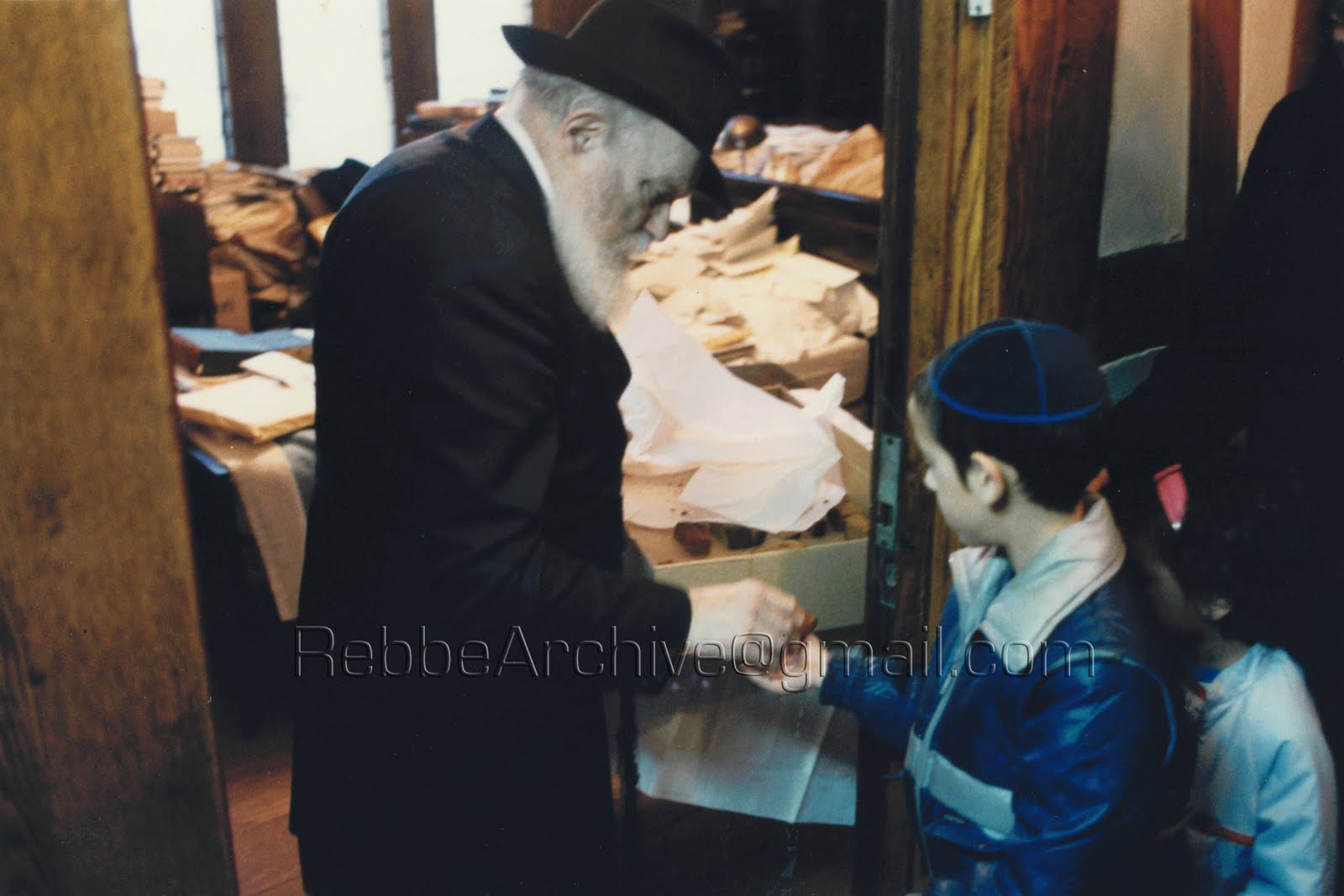
Is the mechitzah in shul really necessary? Or is it a “male plot” to degrade Jewish women? And given the stress these days on Jewish unity, why make separations altogether? In the following letter to the president of a Brooklyn synagogue, the Rebbe spells out the reasons for a mechitzah, its impact on communal prayer, and the answer to a question on those who seem communally farthest away. We would like to thank Rabbi Simpson, a member of the Rebbe’s secretariat, for this letter.
The Rebbe Archive would like to present two unique photos of the Rebbe leaving 770 in the winter of 1975, on his way to the gravesite of his father-in-law. With special thanks to Hayward family for the photos.
Good Shabbos
Menachem
By the Grace of G-d
10th of Nissan, 5721
Brooklyn, NY
Greeting and Blessing:
This is in reply to your letter and questions:
(1) Regarding the mechitzah in the synagogue.
You mention several explanations which have been suggested to you, according to which the necessity for a mechitzah would be qualified and limited to certain conditions only.
Let me preface my answer with a general observation about a misconception in this matter. It is a mistake to think that the mechitzah is degrading to the honor or dignity of the Jewish woman. The best proof of this is that although the love of parents for their children is not only a very natural one, but has even been hallowed by the Torah, as we pray to G-d to show us the same fatherly feeling (“As a father has mercy on his children”), yet there is a din in the Shulchan Aruch that it is forbidden to kiss one’s children in shul, and, moreover, even not during the time of prayer. Not to mention the din of the Torah to esteem and honor every human being created in the “image” of G-d. To think that there could be anything degrading in the mechitzah is to betray complete ignorance not only of the significance of the mechitzah but of the whole attitude and way of the Torah.
One of the inner and essential reasons for the mechitzah—since you insist on an explanation—is that the synagogue, and the time of prayer in general (even when recited at home), are not merely the place and time when a formal petition is offered to Him Who is able to fulfill the petition; it is much more profound than that. It is the time and place when the person offering the prayer unites himself with Him to Whom the prayer is offered, by means of the prayer. And as our Sages declare: Know before Whom you stand: before the Supreme King of kings, the Holy One, blessed be He. “Know” (da), as the term daas is explained in the Tanya, in the sense of unity, as in “And Adam knew Eve.” The union of two things can be complete only when there is not a third element involved, be it even a matter of holiness and the like.
From the above it follows that there certainly must be nothing to distract the attention and the attunement of the heart and mind towards the attainment of the highest degree of unity with G-d.
From the above it also follows that the separation of the sexes by a mechitzah has nothing to do with any particular condition or state in the women, as has been suggested to you.
It further follows also that the purpose of the mechitzah is not just to set up a visible boundary for which a mechitzah of several inches might do, but it must be one that completely hides the view, otherwise a mechitzah does not accomplish its purpose.
I have indicated above, though quite briefly, some of the basic facts about a mechitzah and the essential explanation behind it in order to answer your questions and satisfy your curiosity. I must say, however, quite emphatically, that the approach of measuring Torah and mitzvoth by the yardstick of the limited and often fallacious human reason is totally wrong. The human intellect is a very unreliable gauge, and quite changeable from one extreme to the other. Even in the so-called exact sciences, the unreliability of human reason and deduction has been amply demonstrated, and what was one day considered as an “absolute” truth is the next day abrogated with equal certainty and absoluteness. Hence to presume to make conditions in regard to the eternal and G-d-given Torah and mitzvoth is completely out of place.
Therefore, inasmuch as we have been instructed to have a mechitzah in the house of prayer, it would violate even the common sense to present a petition to the Almighty in a manner which displeases Him, and to add insult to injury, to declare that “the reason I do not accept this regulation is because my human intelligence suggests to act otherwise than is the will of the En Sof, yet, please fulfill my request anyway!”
Much more should be said on this subject, but it is difficult to do so in a letter.
(2) You ask, how can one accept the mishnah “All Israel have a portion in the world to come” and how, by the widest stretch of the imagination, can one believe that the worst apikores will have a share in the world to come?
The answer to your question may be found in various sources and is especially illuminated in the sources of Chassidus at length.
The belief of our Jewish people in true Monotheism is, of course, the very basis of our faith and way of life. This means not only that there is only One G-d and none other beside Him, but “nothing else beside Him” (ein od milvado). The whole Creation and all the worlds have no reality of their own, for there is only one Reality—G-d, inasmuch as a spark of G-dliness animates and keeps everything in existence, as it is written, “By the word of G-d the heavens were created,” etc. This “word” of G-d is the essence and reality of everything.
Thus, the individual you call “apikores” is also animated by the “word” of G-d, which is surely eternal, for that individual is also a part of Creation and is animated and sustained in the same way. Except that it was the will of the Creator that this individual, created by the word of G-d, should have complete freedom to choose good or bad, life or death, as it is written, “Behold, I place before you this day life and good, and death and evil.” The individual who misuses this gift of freedom and chooses evil loses and forfeits that part of this G-d-given energy which went into the commission of the sin or omission of the mitzvah, which, had he chosen otherwise, would have been imbued with an eternal quality. However, the very essence of his reality, that is, that which has been created and came into being by the word of G-d, cannot be destroyed, so long as it retains its essential character. It can only be soiled and stained by sin, G-d forbid.
But inasmuch as every individual Jew is a “whole world,” as our Sages said, and, moreover, the whole universe was created for his sake, and as the Sages commented on the word Breishis—for the sake of Yisroel called “Reishis,” the Jew who sinned most undergo various transformations and stages of purgatory to be cleansed of the impurities which had attached themselves to his soul, which is his essence, and which has a portion in the world to come because of its eternal quality.
This is also what our Sages meant when they succinctly said—as they often compress a far-reaching idea into a few concise words by way of explanation immediately following the statement in the said mishnah of Kol Yisroel: “For it is written, ‘and Thy people are all righteous . . . a branch of My planting, the work of My hand to be glorified (by them).’” Because every Jew contains in him something which is like a branch of the Divine Tree and the work of G-d’s own hands, it is eternal, and that is why “every Jew has a portion in the world to come.”
I trust that in harmony with your search for knowledge which you display in your letter, you have regular daily periods of study of the Torah and the Torah view, and that is the kind of study which leads to action and practice in the daily life, as our Sages emphasized that the essential thing is the deed.
The enclosed message will surely be of interest to you.
Wishing you and your fellow students a kosher, happy and inspiring Pesach.
With blessing,
[Signature]
Wednesday, December 1, 2010
How to Deal with a Jews Challenges - Insightful Letter of the Rebbe

Jews in the world today face a myriad of issues. Is it still possible, or simple, to be a practicing Jew? The Avner Institute would like to present a first-time released letter to a Jew in Europe in which the Rebbe derives from the story of Chanukah a powerful message on overcoming daily challenges.
“Chanukah Live” was an event involving thousands of Jews who would join together with the Rebbe at “770,” Chabad headquarters. The Rebbe Archive would like to present two magnificent photos from “Chanukah Live” 1991, where holiday celebrations in New York, Paris, Moscow, Melbourne, Hong Kong and Jerusalem were united by satellite hookup. In the first photo you can see the Rebbe watching the menorah lighting in New York with Rabbi Shmuel Butman and mayor David Dinkins.
Good Shabbos
Menachem
By the Grace of G-d
22nd of Kislev 5732
Brooklyn, NY
Greeting and Blessing:
I received your letter and, as requested, I will remember you in prayer when visiting the holy resting place of my father-in-law of saintly memory.
It is purely unnecessary for me to emphasize to you that the daily conduct in accordance with the Torah and mitzvoth is the channel and vessel to receive G-d’s blessings. Therefore, every additional effort in this direction brings with it additional Divine blessings in all one’s needs.
If it sometimes appears difficult to follow the Jewish way of life in a world under circumstances which are not conducive to it, the difficulty is imaginary than real, and when there is a will and determination, all obstacles can be overcome. This is also the message of Chanukah, which we are soon to celebrate, which teaches us that with selfless determination even a small and weak minority can overcome a strong and large minority, just as a small light dispels a lot of darkness. I trust you will spread the light of the Torah and mitzvoth all around you and in a growing measure, which is the essential lesson of the mitzvah of Chanukah lights which we kindle in increasing numbers each night of Chanukah.
Hoping to hear good news from you,
With blessing,
[signature]
Wednesday, November 17, 2010
Encounter With The Lubavitcher Rebbe & Rabbi Moshe Feinstein ZT’L

Regarding tefillin, the black leather casing donned by Jewish men during prayer, the Torah commands (Deut. 6:8): “Bind them as a sign upon your arm and they shall be for tefillin between your eyes.” Tefillin, which contain the four Scriptural passages mentioning this mitzvah, are worn differently, according to custom and community, and the “Rashi” tefillin was the pair for a Lubavitcher boy becoming bar mitzvah. However, during a public talk in 1976, the Rebbe mentioned the importance of donning two pairs of tefillin instead of one – a practice commonly known as “tefillin d’Rabbeinu Tam.”
This practice was slowly integrated into the Lubavitcher community. But there were those outside of Lubavitcher circles who adopted the practice as well—among them Rabbi Moshe Feinstein (1895-1986), the most prominent scholar and authority of his day, whose Igrot Moshe, a compilation of responsa, addressed numerous legal and ethical issues. Who encouraged Rabbi Feinstein to follow the Rebbe’s directive? The following story contains fascinating details of this came about thanks to one of the Rebbe’s ardent supporters.
The Rebbe Archive presents two newly released photos of the Rebbe from 6 Tishrei 5732/ 1971, with special thanks to the Minkowitz family.
Good Shabbos
Menachem
The Rebbe's Announcement
It was Purim, 5736/1976. The farbrengen, the Chassidic gathering, was in full sway, and the listeners were particularly festive, given the celebration of that glorious ancient holiday. It was enough to hear the Rebbe’s words extolling the triumph of Esther and Mordechai to feel the joy and energy.
Suddenly the Rebbe changed the topic and began to speak about the merits of putting on Rabbeinu Tam tefillin (in addition to the more widely used Rashi tefillin). On the tape recording one can hear the Rebbe say (in a voice that is especially mellifluous), “This is the place to clarify and respond to a question many have … the question of whether to put on Rabbeinu Tam tefillin. My view is clear that now is the time to put on two pairs of tefillin . . . . It is obligatory, during the times of the footsteps of Moshiach, to also put on Rabbeinu Tam tefillin . . . . Whoever wishes to should put on Rabeinu Tam tefillin in addition to Rashi tefillin will be blessed.”
To those gathered at the farbrengen, it was quite a shock. Although the Alter Rebbe (the first Lubavitcher Rebbe, Shneur Zalman of Liadi) writes in Piskei Ha’Siddur that every G-d fearing man should lay Rabbeinu Tam tefillin, Chabad Chassidim waited for the Rebbe’s permission, and not till after their wedding. Rarely—and only with authorization—did bar mitzvah boys do so! Nevertheless, in the sicha of parshat Va’eschanan 5749/1989, the Rebbe advised that they be worn even in the two months prior to the bar mitzvah.
Gradually, as a result of the Rebbe’s instruction, his followers began to don Rabeinu Tam tefillin. Yet, surprisingly, they were not the only ones. The legal authority of the time, Rabbi Moshe Feinstein zt”l, then Rosh Yeshivat Mesivtha Tifereth Jerusalem (MTJ) on the Lower East Side, also decided to take on this practice, despite not having heard the Rebbe directly. There is a fascinating story behind this that is being shared to mark the 41st year of Mitzvah Tefillin, which the Rebbe initiated on Lag B’Omer 1967.
In the years after Mitzvah Tefillin was introduced, Rabbi Tzvi Hersh Spritzer worked assiduously to influence Jews to put on tefillin. In order to facilitate the daily practice, he would persuade them to buy a pair of tefillin, which ranged from $30 to $40 (the equivalent of $250 today), and strived to get the lowest price by purchasing the four Scriptural verses (parshiot) from a sofer (scribe), the battim (casings) from someone else, and the straps from yet a third person.
In 1974 the Rebbe announced Mitzvah Mezuzah, where he asked that every Jewish home have kosher mezuzos. The Rebbe compared a mezuzah to a helmet that protects one from harm. Rabbi Hershel threw himself into this campaign too, and made sure that affordable mezuzos were put up in hundreds of Jewish homes.
Fateful Encounter
One year, on the plane back from Eretz Yisrael where he had visited his father, a distinguished Belzer Chassid, Rabbi Hershel took out a sefer and invited his seatmate to join him. When this seatmate introduced himself as Rabbi Dr. Moshe Tendler and Rabbi Moshe Feinstein’s son-in-law, Rabbi Spritzer thought this a good opportunity to reach Rabbi Feinstein. Describing the Rebbe’s mitzvah campaigns he asked, “When were Rabbi Feinstein’s mezuzos last checked?”
Rabbi Dr. Tendler was taken aback. He didn’t know what to say. He was unaware of when they were last checked and who had checked them. Despite his father-in-law’s having the finest mezuzos, they, like all mezuzos, needed to be checked periodically. Rabbi Hershel offered to do this and return them as quickly as possible.
A day or two later, Rabbi Hershel went to the home of Rabbi Moshe Feinstein to collect the mezuzos and bring them to the scribe. He then submitted a report of his activities to the Rebbe. Since the Rebbe had spoken of the importance of putting on Rabeinu Tam tefillin, Rabbi Spritzer considered discussing this with Rabbi Feinstein and the next day made an appointment, scheduled for a Wednesday a few weeks later.
Avid Listener
When he met Rabbi Feinstein and brought up the subject, he was surprised to learn that the sage had put on Rabbeinu Tam until age eighteen but then stopped. Rabbi Feinstein asked, “What did the Rebbe say at the farbrengen?”, and added that he would happily comply if the Rebbe were involved in their procurement—picking the scribe to write the verses and giving his opinion on the other details.
At Rabbi Feinstein’s request for the Beis Yosef script, Rabbi Hershel went that very day and asked Rabbi Eliezer Zirkind, a friend and scribe in Crown Heights, whether he could oblige. After Rabbi Hershel explained who the tefillin were for and the importance of having the revered leader put on Rabbeinu Tam, Rabbi Zirkind agreed to write them in Beis Yosef script specially for Rabbi Feinstein.
Rabbi Hershel immediately wrote to the Rebbe about the developments. A few hours later, at midnight, the phone rang at Rabbi Zirkind’s house. Mrs. Zirkind answered the phone.
The Rebbe’s secretary Rabbi Hodakov, asked, “Is Rabbi Zirkind awake?”
When a groggy Rabbi Zirkind came to the phone, Rabbi Hodakov asked whether he could come to the office right away. Shortly after, Rabbi Zirkind knocked on Rabbi Hodakov’s office door at 770.
“The Rebbe asked that you meet with Rabbi Feinstein to discuss the details of the
writing of the tefillin,” Rabbi Hodakov explained. “The meeting has already been arranged. Tomorrow at nine, Rabbi Feinstein will be waiting.”
The next day Rabbi Zirkind met with Rabbi Feinstein and introduced himself as the sofer who met the Rebbe’s approval and was proficient in Beis Yosef script. Rabbi Feinstein, greatly pleased, began discussing the writing. One of Rabbi Feinstein’s requests regarded the way in which Rabbi Zirkind should write the tefillin. Based on Kabbalah, Rabbi Zirkind generally wrote tefillin without interruption, not even speaking until after placing the verses into the boxes. The process took at least eight hours. Rabbi Feinstein asked that, given the Beis Yosef script, which Rabbi Zirkind didn’t usually write, each section be written separately. Rabbi Feinstein wanted to inspect each one upon completion before the next would be written.
Rabbi Zirkind sat down to write the first verse the very next day. When he was done, he sent it to Rabbi Feinstein, then went on to the next section.
The writing of the tefillin was completed two days later, on a Sunday afternoon. After Rabbi Feinstein approved all of the sections, Rabbi Zirkind brought them to him in size four by four-inch boxes, according to Chabad custom. After placing the tefillin on his head to check the size, Rabbi Feinstein asked for smaller boxes, since a small part of the base did not lay flat on his forehead. The boxes changed, Rabbi Zirkind brought the tefillin to Rabbi Feinstein, who resumed laying Rabeinu Tam that very same day.
The Rebbe's Letter
A letter from Rabbi Feinstein, dated Erev Shabbos Shekalim 5740, to the Rebbe appears in volume eight of Rabbi Feinstein’s Igros Moshe in which Rabbi Feinstein thanks the Rebbe for his help and mentions that in his youth, when he lived in Lublin, he had put on Rabbeinu Tam regularly. “I put them on after davening but on condition that it would be bli neder [without a promise]. But when questions arose about whether one could fulfill the mitzvah according to the view of Rabbeinu Tam, I did not do so anymore.”
Rabbi Feinstein humbly thanks the Rebbe for urging the wearing of Rabbeinu Tam tefillin. “And now, when I was informed in the name of the Rebbe that there are parshiyos of tefillin d’Rabbeinu Tam for me, to my specifications, this is a great thing, aside from being able to also fulfill the mitzvah of putting on tefillin d’Rabeinu Tam as I was accustomed to doing. As for the money, I thank Hashem Who helped me and will help me pay the sofer what he asks for, and the sofer will get good battim … and surely the sofer will also write ksav Beis Yosef.” Rabbi Feinstein ends the letter with the salutation, “who greatly esteems him [the Rebbe].”
A few days went by and Rabbi Feinstein received a response from the Rebbe in which the Rebbe acknowledged his letter and made some points about tefillin Rabbeinu Tam. In the letter, the Rebbe writes (free translation):
The Rabbi and Gaon… Rabbi Moshe Feinstein
Subsequent to inquiring after Shalom Toraso!
Recently, I received two letters from Kvod Toraso (of 27 Shevat and Erev Shabbos Shekalim) and am responding with haste to thank and bless you for the brachos and wishes, etc. And mainly as it says explicitly in the verse: “I will bless those who bless you” – Hashem with His blessing and His addition to the blessing, which is greater than the original (Devarim Rabba 1:13) and in Berachos (55a) – that you should live long, good days and years. And especially, since you attached a response discussing a number of matters regarding tefillin and the conclusion regarding the actual practice of tefillin (d’Rabbeinu Tam). And being that the middah [trait] of HaKadosh Baruch Hu is measure for measure with (but many times more), then according to this, (an increase in) one who puts on tefillin (brings an increase in the reward of) lengthens his days as it says, “Hashem is upon them, may they live… and He should fortify me (with health) and grant me life (end of Menachos 44a).” Particularly as regards (the arm that is opposite) the heart and (the head that is opposite) the brain – Chabad of our Holy Torah all the way to drawing conclusions according to halacha.
With honor and esteem and manifold blessings,
M. Schneersohn
Wednesday, November 10, 2010


Subscribe to:
Posts (Atom)
